
By Prof Mark Winfield
The outcome of the recent federal election 鈥� a Liberal minority dependent on the NDP or Bloc Qu茅b茅cois for support 鈥� has been widely seen as having a 鈥淕roundhog Day鈥� aspect to it. It left the composition of Parliament very much as it was before,听听of the election in the first place.
Yet the election has major implications for Canada鈥檚 approach to climate change and other environmental issues. Many progressives likely wanted the result: a Liberal government 鈥� but one they may not entirely trust to meet its promises on climate, child care and a host of other issues 鈥� reliant on more progressive parties to stay in office.
The overall outcome may have actually left Canada better positioned than before the election to make significant progress on reducing its greenhouse gas emissions.
Holding the progressive vote
The Liberals鈥� efforts to hold onto progressive voters in the face of challenges from the NDP, Greens and, in Qu茅bec, the Bloc Qu茅b茅cois, translated into an impressive menu of climate commitments.
Even before the election, the government expanded听听to a 40 to 45 per cent reduction by 2030 relative to 2005. (Canada鈥檚 previous target had been 30 per cent below 2005 levels.)
Canada has also said it will听. Under that scenario, the details of which have yet to be听, any remaining greenhouse gas emissions would have to be balanced by the amounts absorbed by biological processes (such as growing trees) and carbon sequestration or storage technologies.
The government鈥檚 December 2020听听proposed to increase the backstop federal carbon price to $170 per tonne by 2030. It is now expected to follow through on that.
The campaign produced听听hits net-zero emissions by 2050, 鈥渨ith five-year targets starting in 2025.鈥� There were also commitments to a听听reduction in fossil industry methane emissions from 2012 levels by 2030, and to 鈥渄evelop a plan to听听public financing of the fossil fuel sector, including from Crown corporations.鈥�
Electricity, transportation and buildings
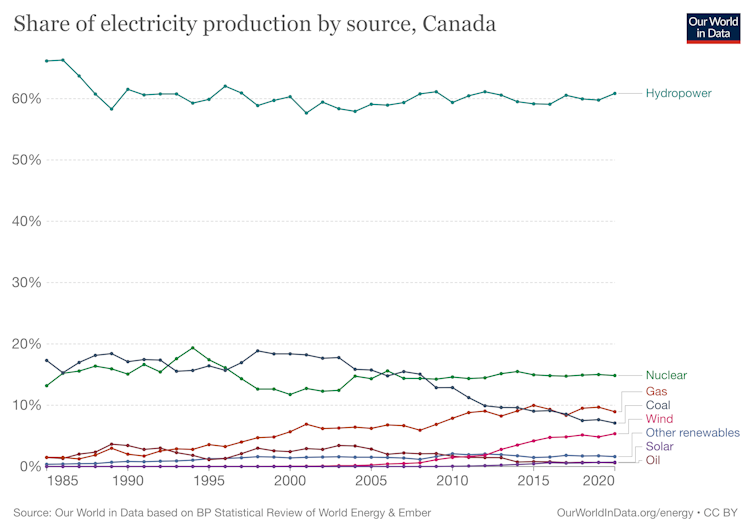
About 17 per cent of Canada鈥檚 electricity comes from fossil fuels. In addition to the planned phase-out of conventional coal-fired electricity generation by 2030, a proposed 鈥溾�� would bring the electricity grid to net-zero by 2035.听听exports would end by 2030.
Transportation is the听. The federal government has听听so that every new passenger vehicle sold in 2035 and beyond is a zero-emission vehicle (ZEV). The commitments come with electric vehicle rebates of up to $5,000 for 500,000 buyers, plus 50,000 new charging stations across the country. And a low-carbon fuel standard would reduce emissions from gas-burning vehicles that remain on the road.
For homes and buildings, which account for about 13 per cent of Canada鈥檚 emissions, the government has听, with interest-free loans of up to $40,000 for deeper retrofits. There will also be a national strategy to bring the building stock to net-zero by 2050 with 鈥渁mbitious milestones along the way.鈥�
Following through will be crucial
The crucial question now will be the follow-though on these commitments. Many of the government鈥檚 promises, like the commitments to reduce fossil fuel and electricity sector emissions, could lead to significant federal-provincial conflicts, particularly with Alberta and Saskatchewan.
Over the past six years, the Liberals鈥� approach to addressing climate change has had some profound contradictions. The government purchased and approved the听, and it has supported controversial technologies like听,听, and fossil-fuel dependent 鈥渂lue鈥� and 鈥済rey鈥澨�.
To its credit, Prime Minister Justin Trudeau鈥檚 government had already implemented far more substantive climate policies than all of its predecessors, Liberal and Conservative, combined. The government鈥檚 minority status, dependent on two opposition parties with strong commitments to climate action, will help see these further commitments through to implementation, even if some say its听.
The election also had significant implications for the other parties. The credibility of the Conservative party鈥檚 stance on climate change remains suspect, and is reinforced by the听听of the Stephen Harper government and the behaviour of current Conservative provincial governments听,听听.听听to its lowest level in two decades, yet the听听among progressive voters despite a relatively strong campaign performance by Jagmeet Singh.
The overall results have left Canada reasonably well-positioned to move forward on its climate commitments. The question now will be whether the re-elected Trudeau government will carry through on its promises. Its survival through the next federal election may well depend on the results.
With files from . See full article .