
By
The speech from the throne is only weeks away. Moments like these — pandemics, depressions, wars — are historical turning points, often marking a time period when fundamental change toward social and economic equality become possible.
Unlike the apparently failed state south of the border that seems to be trudging toward a dystopian future, the federal government has implemented a commendable, if imperfect, plan to protect Canadians’ health and safety, support unemployed workers and help struggling businesses in this time of pandemic-induced shock.
Longer term, Prime Minister Justin Trudeau has promised to rebuild the economy, address inequality and take bold action on the climate emergency. :
“Rising income inequality and a hollowed-out middle class are the dominant social and political challenge facing our generation.”
Will they follow through on these promises? Or will they appease the people who derive their power from wealth — or plutocrats, as Freeland called them in her — and ultimately acquiesce to the parameters they set on what kind of change is acceptable?
So far there has been no mention of a wealth tax or an increase in the income tax rate for the wealthiest Canadians, the rebuilding of the badly frayed social safety net or the expansion of universal health care, notably via universal public pharmacare. Nor have there been any bold measures to decarbonize the economy that align with the government’s net-zero 2050 target.
Debt, deficit drumbeats
Corporate mouthpieces are beating the austerity drums, warning about rampant debt and deficits. The Business Council of Canada is urging the government to set clear fiscal targets and rein in spending to control the debt.
The Fitch credit rating agency — which in 2007 disastrously rated sub-prime mortgage bonds as Triple A, a contributing factor to the global financial crisis — has downgraded due to the “deterioration of Canada’s public finances.” It’s also given a nod to Conservative Leader Erin O'Toole’s pledge to balance the budget.
As a result of government spending, the this year and next. That’s paltry compared to its rise to 130 per cent during the . No one complained then. There was a war to fight.
Bank of Canada Governor Tiff Macklem is seen during a news conference in July 2020 in Ottawa. THE CANADIAN PRESS/Adrian Wyld
— creating money by purchasing government debt at virtually zero interest rates — to prevent an even deeper tanking of the economy.
It should continue to do so — — in order to rebuild a fragmented economy and social state and lead the green transition. Japan has been doing this for years, with the Bank of Japan owning the bulk of government debt.
As Nobel prize-winning economist Paul Krugman wrote earlier this year: “.”
This is not to say that the government can run fiscal deficits indefinitely. Federal tax revenues have fallen as a share of GDP over the past 30 to 40 years. . They need to be rebuilt.
Income gap grows
Income and wealth inequality have risen to unprecedented levels over the past four decades. The pandemic has laid bare the consequences of this new gilded age.
In 1971, the top marginal .
Tax brackets have been reduced from 17 to four. More importantly, the bulk of the wealthiest Canadians’ incomes are not from wages, but from their , which are taxed as capital gains at very low levels and only kick in when shares are sold.
Median household income in Canada , while the average income of the richest one per cent has increased dramatically, doubling between 1982 and 2010 and widening further over the last decade.
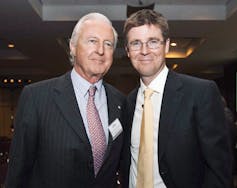
Galen Weston Jr., right, Loblaw Companies Ltd. executive chairman, poses with and his father Galen Weston Sr., at the company’s annual general meeting in Toronto in May 2010. The Westons are among the richest families in Canada. THE CANADIAN PRESS/Nathan Denette
According to recent estimates by the , the top one per cent of Canadian families hold 25 per cent of total family wealth.
The bottom 40 per cent of families hold basically no wealth, while the 1,000 richest families have some $325 billion in combined wealth. This contrasts with the total $3 billion combined wealth held by 12.8 million Canadian families. True to form, the in Canada saw their wealth increase by nine per cent in the first three months of the pandemic.
Tax avoidance
The system has created massive opportunities for tax avoidance by the richest Canadians and large corporations. in the leading 12 offshore tax havens reached $381 billion in 2019.
The Canada Revenue Agency estimates approximately every year from funds that wealthy Canadians have sequestered in offshore tax havens.
The inequality gap will most definitely continue to rise over the next 10 years without a wealth or estate tax on the richest Canadians, without increasing the income and capital gains tax rate on the richest Canadians and without closing tax loopholes.
Climate emergency
In his new book, , urban studies professor Seth Klein laments the new climate denialism that involves governments and industry leaders verbally accepting climate science but denying what the reality means for policy. Governments promise action but practise appeasement of corporate interests, delivering “underwhelming and contradictory policies.”
Governments have been for nearly three decades. .
Mark Carney is seen in this 2016 photo, when he was serving as governor of the Bank of England. THE CANADIAN PRESS/Chris Young
— formerly the Bank of Canada and Bank of England governor, and now a special envoy for climate action for the United Nations — has warned that climate is approaching a tipping point that could precipitate global financial and economic collapse, to say nothing of a planetary apocalypse. Carney is now serving as an adviser to the Trudeau government.
A recent report estimated Canada’s emissions in 2030 would be 15 per cent above its Paris accord reduction target of 30 per cent over 2005 levels. That’s part of a growing global disconnect between rising temperature trends and commitments by governments to cut emissions.
on the way to achieving net-zero emissions by 2050. He promised that concrete actions, including legally binding five-year targets, would be revealed before the next UN climate summit in November.
Canadians want a wealth tax
Canada needs an ambitious social and economic plan that will hopefully present itself in the upcoming throne speech.
A recent found 74 per cent of Canadians believe the government should introduce a wealth tax of one to two per cent of the very rich.
It also found 72 per cent of Canadians supported a universal public pharmacare program. The Liberal government has waffled for decades on pharmacare and continues to do so, even in the face of recommendations from on the need for it.
On climate, the Abacus poll found that the transition to a low-carbon economy was “extremely or very important” to 53 per cent of Canadians and “important” to another 20 per cent.
Will the public be heeded in the throne speech and the government’s subsequent fiscal update? Will there be a pledge for transformative change or will the plutocracy be appeased once again?
Tilting the scales towards change requires a broad-based, engaged movement. Canadians must mobilize.
With files from . See .