

is a professor of Critical Development Studies, a postcolonial scholar, and one of the first to bring both psychoanalysis and postcoloniality to the field of Development Studies. He first came to prominence in the early 2000s through a series of journal articles on participatory development, that is, the practice of involving beneficiaries of international development programs in decision-making. Critical of such a practice, he argues that while it seems noble and promising when adopted by international development agencies, it can be used as an excuse to advance neoliberal policies and result, ironically, in authoritarian and exclusionary practices.
His current research explores how psychoanalysis intersects with international development, analyzing case studies of psychoanalytic phenomena from both the Geography and Development Studies literatures. Particular attention is paid to illustrating psychoanalytic operations in development theory and practice, emphasizing that trauma (e.g. socioeconomic inequality, racism, gender discrimination) is not just an “inner” condition but is externally materialized in institutional policies and programmes. His field work focuses on the activities of the World Bank, the UK Department for International Development, and development NGOs in India.
Professor Kapoor is the author of four books and numerous journal articles on postcolonial politics, psychoanalysis, and participatory development.
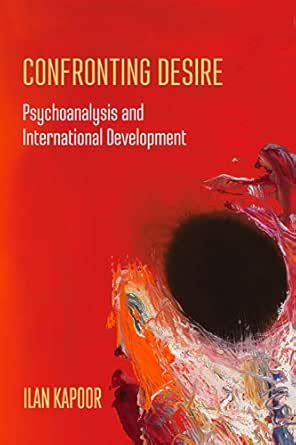
His just-published book, by Cornell University Press, is entitled, : it applies a psychoanalytic lens to key themes, concepts, and practices underlying the development enterprise, offering a new way of analyzing the problems, challenges, and potentialities of international development. Kapoor makes a case for examining development's unconscious desires, and in the process inaugurates a new field of study: psychoanalytic development studies. Gayatri Chakravorty Spivak, in her review of the book, sees it as “required reading,” suggesting that “movements for change must take [Kapoor’s analysis] into account.” And geographer Uma Kothari characterizes it as a “shimmeringly insightful and truly ground breaking book [alerting] us to the unconscious impulses and desires that continue to influence contemporary development thinking and practice, [while] offering a progressive future radical politics.”
In Kapoor’s edited volume, (2018), contributors use psychoanalysis to expose the unconscious desires, excesses, and antagonisms that accompany the world of economic flows, cultural circulation, and sociopolitical change. The book adopts a psychoanalytic lens to highlight the unconscious circuits of enjoyment, racism, and anxiety that trouble, if not undermine, globalization’s economic, cultural, and environmental goals or gains. Slavoj Žižek describes the book as “obligatory reading, not only for those who want to penetrate the dark underside of our social life but also for those who want to bring out the economic and political mediation of our most intimate traumas.”
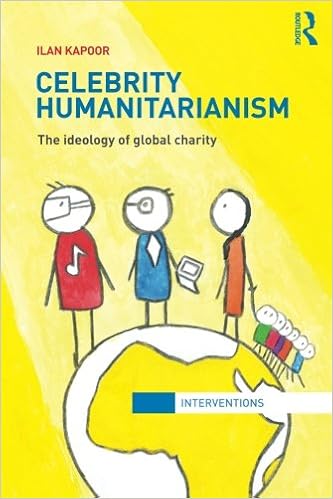
(2013) was one of the first to critically analyze “celebrity” forms of global humanitarianism and charity work. The book argues that celebrity humanitarianism legitimates and promotes neoliberal capitalism and global inequality. Reviews of the book portray it as a “brilliant Žižekian analysis” and a “landmark in the critique of ideology.”
(2008) examines the intersection of postcolonial theory and development studies. It questions development’s dominant cultural representations and institutional practices, while also investigating the possibilities for a transformative postcolonial politics. In addition to be reviewed as “very stylish,” the book is seen as “offering powerful ... illustrations of ... practical political agendas for development studies,” while also representing “a small theoretical revolution that will hopefully make academia better prepared to grasp the meanings of politics in the postcolonial world.”
With philosopher Zahi Zalloua, Kapoor has just completed a co-authored book manuscript on Universal Politics, currently under review at Oxford University Press.
Professor Kapoor obtained his PhD from the University of Toronto in Political Science, specializing in Comparative Politics and Political Theory. He did his Master’s in International Affairs at the Norman Paterson School of International Affairs at Carleton University, Ottawa. Before joining FES, he worked as an independent consultant for such organizations as the International Council for Local Environmental Initiatives, the International Centre for Human Rights and Democratic Development, the Canadian International Development Agency, the International Development Research Centre, and the United Nations Development Programme.