

Ontario election: 4 ways Doug Ford has changed the province鈥檚 politics
The dismal environmental record of the Doug Ford government in Ontario . Despite some the steel sector and , the province is on track to see major increases in greenhouse gas emissions, particularly from the .
The government鈥檚 emphasis on in the Greater Toronto Area is further evidence of this trend.
The Ford government鈥檚 record on environmental issues is an extension of its wider approach to governance. It has broken from the of Ontario politics, which have emphasized moderation and administrative competence, .
Looking back on Ford鈥檚 four years in power reveals four themes about his approach to governance 鈥� and what the next four years might have in store if .
1. Reactive governance
The Ford government鈥檚 agenda seems driven by . It came to power with scant vision for what a provincial government other than cut taxes, red tape and hydro rates. It鈥檚 struggled when confronted with more complex problems that required the province to play a much more active role.
The resulting governance model has been fundamentally reactive, and perspectives. The government has tended to act once a situation reaches the crisis stage, rather than identifying potential problems and taking action to prevent them.
This pattern has been most evident in the government鈥檚 hesitant responses to the . It tended to waves of COVID-19 infections rather than anticipating them and taking measures to minimize their impacts, even when given clear and consistent to do so.

Issues like the environment and climate change are destined to do poorly under such a reactive governance model. They require taking action now to avoid problems in the future.
We are constantly reminded of this by the reports of the and and environmental commissioners. Only responding when problems have become too obvious to ignore tends to mean it鈥檚 already too late.
2. Creeping authoritarianism
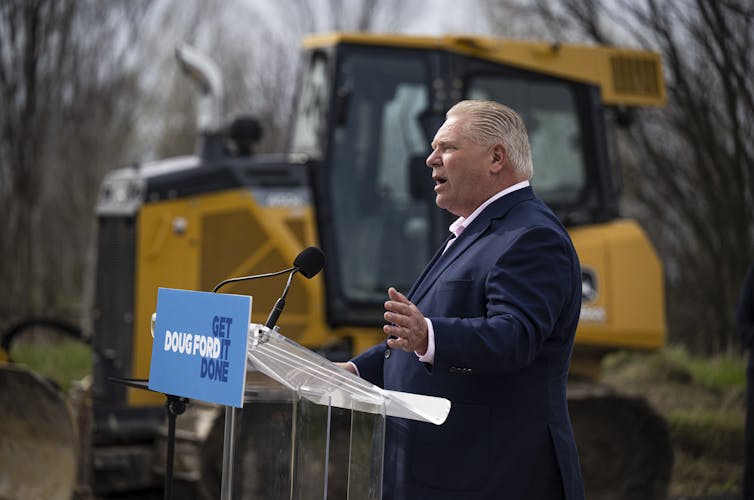
The government鈥檚 run-up to the election has placed a strong emphasis on 鈥溾�� 鈥� it鈥檚 the Progressive Conservative party鈥檚 campaign slogan 鈥� in areas like housing and highway and transit construction, in particular.
The flip side of this emphasis has been increasingly aggressive exercises of provincial authority, particularly over local governments. One of the government鈥檚 first moves was to arbitrarily cut in half. The province threatened to invoke, for the first time in the province鈥檚 history, of the Charter of Rights and Freedoms, known as the notwithstanding clause, to get its way.
翱苍迟补谤颈辞鈥檚&苍产蝉辫; have also been rewritten, not only at the provincial level, but down to the level of within individual municipalities, almost universally in favour of developers鈥� interests. 鈥� which circumvent local planning processes and public consultations, designating land use without the possibility of appeals 鈥� are no longer the exceptions they once were.
Instead, they seem the new norm for planning in Ontario. Broad powers have been given to provincial agencies, most notably the , to build what are often and transit projects.
The province鈥檚 have sought the roles of local governments in planning matters and to eliminate public consultation requirements as red tape.
The notwithstanding clause was ultimately invoked by the government as it pertained to its that seemed designed to silence potential critics.
Even local were forbidden to adopt COVID-19 containment measures more stringent that those put in place at the provincial level.
3. Friends with benefits
While the Ford government has gone to great lengths to silence voices of critical constituencies, it鈥檚 been extraordinarily open to the voices that support it.
The overall decision-making model that has emerged is based and .
The government has demonstrated a distinct tendency to uncritically accept whatever its favoured industry lobbyists tell it to do. This has been evident in its approaches to , , , , and .

4. Spend but don鈥檛 increase taxes
A final defining feature of the Ford government has been a tendency to disregard the fiscal consequences of its decisions. The focus instead has been on short-term savings for consumers.
The cancellation of the previous Liberal government鈥檚 cap-and-trade system immediately following the 2018 election cost the provincial treasury . Hundreds of were spent cancelling renewable energy projects.
Hydro rates are being artificially lowered through an annual in subsidies from the provincial treasury, money that could otherwise be spent on schools and hospitals. The pre-election cancellation of tolls on Highways 412 and 418 will cost at least over the next 25 years, while the cancellation of vehicle licensing fees will cost the province an estimated each year.
to provincial gasoline taxes would cost nearly $650 million in annual revenues. And the projected deficit on the government鈥檚 was almost $20 billion, a record.
All of this is at odds with previous Progressive Conservative governments in Ontario, which were largely fiscally prudent.
It isn鈥檛 clear yet to what extent the potential political success of a governance model organized around these four themes represents a fundamental break from the traditional norms of Ontario politics. If Ford wins again, is it due to of the alternatives being offered to Ontario voters, or does it signal a permanent realignment in the province鈥檚 politics?
Either way, June 2 could be a watershed moment in the province鈥檚 history, defining a 鈥渘ew normal鈥� for politics in Ontario.


